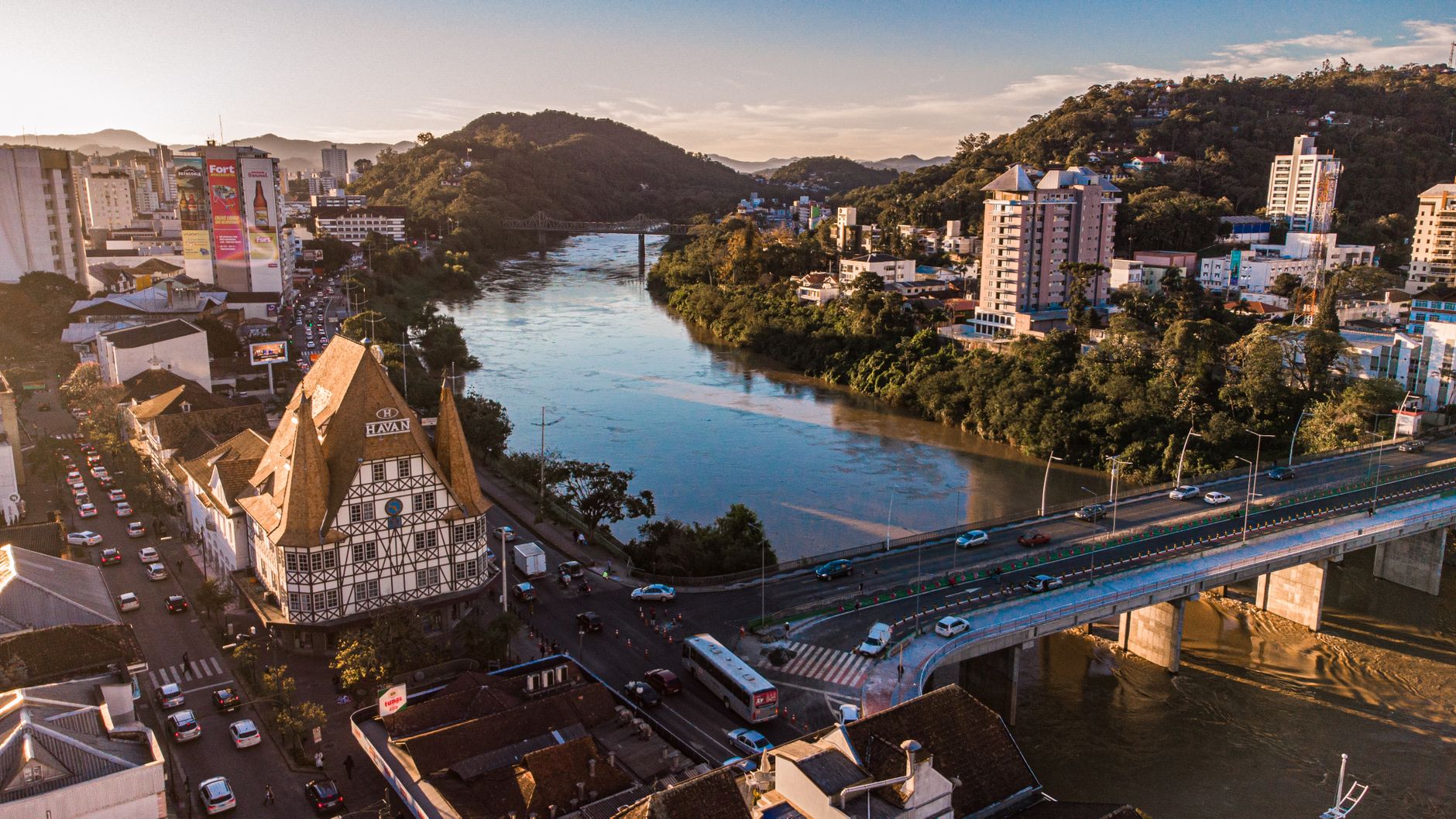
09:00 — Praça Hercílio Luz and the Prefeitura
Start at Praça Hercílio Luz, the square in front of the old city hall. The Prefeitura building itself dates from 1982 but was rebuilt in deliberate Fachwerk style after the original burnt down, and it sets the visual grammar for the rest of the walk. Read the four bronze plaques on the plinth of the Hercílio Luz statue — they name the 1850 founders, and the same surnames repeat on shop windows all day. Coffee at the kiosk in the square is R$5 and the pastel de forno for R$8 is a working breakfast rather than a treat, but the point of stopping is to look at the buildings rather than the plate.
From the square, walk two blocks east to the Ponte de Ferro, the iron bridge that crosses the Rio Itajaí-Açu. It was assembled from a Belgian kit in 1929, still carries pedestrian traffic, and gives you the only clean photograph of the river that runs through everything Blumenau has ever done. The river flooded catastrophically in 1983, 2008 and 2011, and every historic building along the walk carries a small plaque at eye level with the high-water mark of each. This is the context for the whole town: a place that has rebuilt itself in the same style three times inside a lifetime.
10:00 — Rua XV de Novembro
Rua XV de Novembro is the main commercial street and the walk's spine. The pedestrianised section runs about 900 metres and holds the densest concentration of half-timbered facades in Brazil, though only about a third are genuinely old — most were rebuilt in the 1980s in a deliberate heritage push after the tourist boom that followed the first Oktoberfest in 1984. The genuinely 19th-century buildings are numbers 161, 253, 481 and 601, all marked with small blue heritage plaques. Look up: the ground floors have been colonised by phone shops and pharmacies, but the first and second storeys are intact.
The Café Hänsel at number 411 does the best Apfelstrudel on the street, R$18 with a proper black coffee for another R$7. Skip the touristy places with life-size plastic figures out front — they are aimed at bus groups and the food is microwaved. The Confeitaria Hermes at 289 has been baking since 1958 and their brotchen with butter and honey is a R$14 mid-morning stop that puts everything else on the street in perspective. Allow an hour on Rua XV including one bakery stop; longer if you shop for cuckoo clocks, which are R$180 to R$1,400 and mostly imported.
11:30 — Museu da Família Colonial
The Museu da Família Colonial on Alameda Duque de Caxias is the single most important building on the walk. It occupies three original 1860s houses of the founding Blumenau family, connected by a garden, and holds the letters, tools, furniture and photographs of the first two generations of German settlers. Entry is R$12 and the visit takes about 75 minutes if you read the panels, which are in Portuguese and German only — bring a translator app or accept that you are looking rather than reading. The rear garden contains the family cemetery, which is smaller and more sobering than it sounds.
The exhibit that most visitors remember is the room of children's clothes and toys, laid out to show the mortality rate of the first colony — roughly one in three children died before age five in the 1850s and 1860s, mostly of malaria and dysentery from the river. It reframes the whole prettified town outside. When you come out onto Alameda Duque de Caxias, the Fachwerk buildings look less like a theme park and more like what they are, which is the third or fourth iteration of a settlement that has been genuinely hard to keep alive.
13:00 — Lunch at a genuine Kaffee-und-Kuchen house
Cross back over the river via the Ponte de Ferro for lunch at one of the Café Colonial houses in the Vila Itoupava direction — the Frida, the Casa dos Colonos and one or two smaller family-run places serve the full afternoon-coffee spread as a lunch alternative for R$95 to R$135 a head. You get roughly 40 items: house-baked breads, six or seven cold cuts, four cheeses, jams from the surrounding valleys, five hot dishes including marreco recheado (stuffed duck) and eisbein, and a dessert table that runs to 15 items. Two hours minimum. Do not book for the same day; call the day before.
If the Café Colonial format feels excessive at midday, the alternative is Deutsches Eck near the university, which does a proper eisbein with sauerkraut and kartoffelknödel for R$78 in a room the size of a small barn. Both options put you back on the walking route by 15:00. Avoid the restaurants directly on Rua XV — they charge tourist prices for kitchen output that would embarrass a real German household, and locals eat elsewhere. The one exception is Frohsinn on the hillside above town, which is a taxi ride rather than a walk but worth it for dinner rather than lunch.
15:00 — Vila Germânica and the brewery quarter
Vila Germânica is the purpose-built event park that hosts the October Oktoberfest and sits empty for most of the year, which is exactly when to visit. The permanent buildings are open Tuesday to Sunday, there is a small museum of Oktoberfest history (R$10), and the surrounding streets hold the three microbreweries worth the walk. Eisenbahn, Bierland and Das Bier all run brewery tours in the afternoon; Eisenbahn is the largest and most polished, R$45 with three samples, and the tour explains the Reinheitsgebot purity law more seriously than the setting suggests. Book online the morning of.
This is the part of the day where the visit either clicks or does not. If the Oktoberfest theme feels forced — and in a nearly empty April afternoon it can — walk the ten minutes to the Cervejaria Wunder Bier taproom instead, which pours 14 house beers in a working brewery rather than an event hall. A flight of six 100-ml pours is R$38 and the bratwurst plate is R$32. Either way, plan to be here for 90 minutes to two hours. The walk from Vila Germânica back to the town centre is a flat 1.6 kilometres along the river and takes 20 minutes.
18:00 — Sunset from the Mirador do Morro do Aipim
The walk ends where the town's geography finally makes sense. The Mirador do Morro do Aipim sits 280 metres above the valley floor and is reached by a paved road that a taxi takes for R$25 one way — do not attempt to walk it, the last kilometre is 12 per cent gradient and there is no pavement. From the platform you see the whole Itajaí-Açu valley, the industrial zone to the east, the Vila Itoupava German farming valleys to the north, and the beginning of the Serra Geral to the west. Sunset from April to August happens between 17:40 and 18:20; check the day's time before committing.
There is a small kiosk at the top selling beer for R$12 and coxinhas for R$8, which is enough to hold you until dinner. Come back down by 19:00 and eat at one of the restaurants near Rua XV that stay open late — the Bierland taproom does a proper wurstplatte for R$65, or the Restaurant Frohsinn if you booked ahead does the best marreco in town for R$95. Sleep in central Blumenau near Rua XV, where the mid-range hotels run R$280 to R$420 a night; the Vila Germânica area is quieter but adds a 15-minute walk to everything the next morning.
What this walk covers and what it deliberately skips
The 4.8-kilometre loop covers the historic centre, the founding family's house-museum, the river, the brewery quarter and the viewpoint. It deliberately skips the Museu de Ecologia Fritz Müller (worth 90 minutes but 4 kilometres north and only interesting to natural-history readers), the Parque Vila Germânica during festival season (a different, drunker city), and the outlying Pomerode day trip (a separate half-day, best done by car or the intermunicipal bus for R$14 each way). It also skips the shopping malls, which are indistinguishable from malls elsewhere and eat time.
One day is genuinely enough for Blumenau's centre. A second day makes sense only if you add Pomerode, where the German heritage is more intact because the town is smaller and never had the tourist boom that rebuilt Blumenau in its own image. Two days without Pomerode is stretching a good one-day town into a slow one and a half. The right shape is arrive Blumenau evening, walk this route the following day, drive or bus to Pomerode the day after, then continue north to Joinville or south to the coast. That is the itinerary the region actually rewards.
Good to know
Questions, answered
Do I need to speak Portuguese or German to do this walk?
Portuguese basics help but are not essential — the tourist-facing businesses on Rua XV all handle English at menu level. German is useful only at the Museu da Família Colonial, where roughly half the older panels are German-only. Translator apps work fine for the rest.
Is Blumenau worth visiting outside Oktoberfest?
Yes, and arguably more so. From November through August the town operates as a working small city rather than a festival site, hotels are half the October price at R$280 to R$420, restaurants take walk-ins, and the museums and breweries are properly visitable rather than overrun. October is the loud month; the other eleven are the honest ones.
How do I get from Florianópolis to Blumenau without a car?
The intermunicipal bus from Florianópolis rodoviária runs every 90 minutes, takes two and a quarter hours, and costs R$62 to R$78 depending on operator. Blumenau's rodoviária is 3.5 kilometres from Rua XV; a taxi covers it for R$22. The bus is comfortable and reliable; there is no train.
Is the Vila Germânica area walkable from the centre?
Yes, 1.6 kilometres along the river path, flat, about 20 minutes on foot. The path is safe in daylight and reasonably lit until 21:00. After dark, take a R$15 taxi rather than walk — not because the route is dangerous but because it is unlit past the football stadium.
Doing good is the business: every booking through Stay Santa Catarina funds one verified tonne of carbon removal — same room, same price, no markup.
Start your search