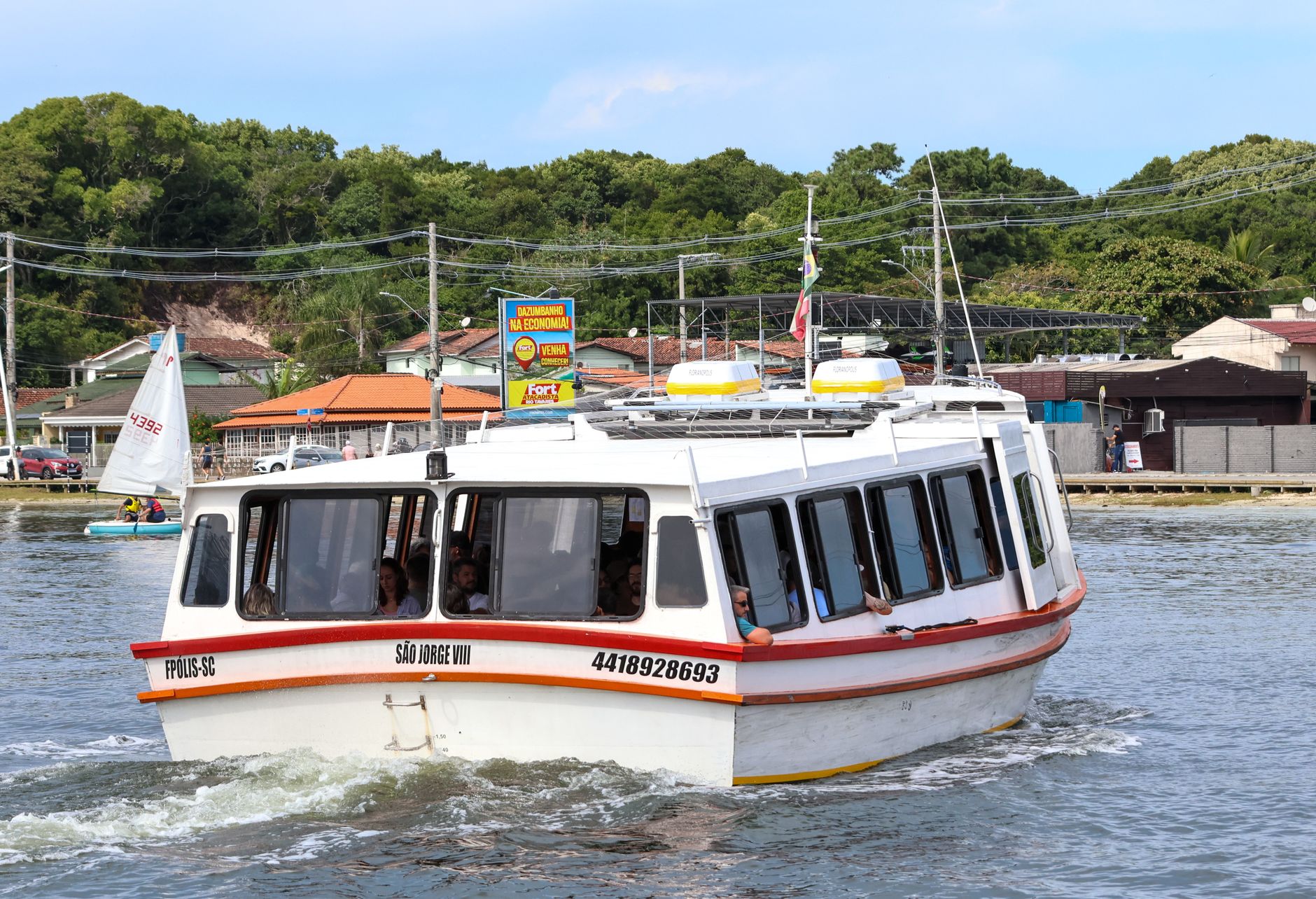
The Sao Francisco do Sul car ferry
The only significant car ferry in Santa Catarina is the crossing of the Baia da Babitonga at Sao Francisco do Sul, connecting Laranjeiras (mainland side, near Joinville) with Sao Francisco do Sul island. The service is run by a state-linked operator, runs roughly every 30-45 minutes from about 6am to 10pm, and takes 15-20 minutes to cross. Cars cost around R$25-35 per crossing depending on size, foot passengers R$4-6. This is the fastest route between Joinville and the island's historic centre; the road alternative via BR-280 adds about 40 minutes and takes you inland. The queues on summer weekends can hit 90 minutes each way — go weekday if possible.
The Sao Francisco do Sul island itself is worth the crossing: the historic Centro is Brazil's third-oldest town (founded 1504), with a walkable colonial core of pastel buildings and one of the best-preserved Portuguese naval museums in the country. Praia da Enseada on the ocean side has calm swimming and R$300-500 pousadas well away from the Florianopolis price bubble. If you are basing yourself in Joinville or Balneario Camboriu, the ferry-plus-island day trip is a genuine highlight that most tourists miss because they do not know the ferry exists. Bring cash — the toll booths sometimes struggle with foreign cards.
Florianopolis to Anhatomirim fort
The passenger ferry from Canasvieiras and Sambaqui piers to Anhatomirim fort (Fortaleza de Santa Cruz) is the most useful tourist boat service on the island. Anhatomirim is a genuinely spectacular 18th-century Portuguese fort on a small island in the northern bay, restored and open as a museum with panoramic bay views. Regular schooner tours include it as one stop among many, but you can also take a direct passenger boat from Sambaqui pier for around R$40-60 return, spending as long as you want at the fort and returning on a later boat. The direct trip is 25 minutes each way.
Timings vary by season and operator — in summer (December-February) there are multiple daily departures from 9am to 4pm; in winter it drops to weekends only or is suspended entirely. Book at the Sambaqui pier the day of, or via one of the small boat operators listed on the Florianopolis tourism office site. Combining it with lunch at Ostradamus (the famous oyster restaurant in nearby Ribeirao da Ilha) makes a full day. If you have already committed to a big schooner tour that includes Anhatomirim, do not double-book; the direct-passenger option is for people who want quality time at the fort itself, not a checkbox visit.
Bombinhas and Porto Belo boat tours
Bombinhas is the small-boat capital of Santa Catarina. From the two main marinas (Porto Belo and Bombinhas central) you can join scheduled group boat tours to Ilha de Porto Belo, Ilha do Arvoredo (a marine reserve — genuine turquoise water, some of the best snorkelling in the state), and the beach circuit around the Bombinhas peninsula. Group tours run R$100-160 per person for a 4-6 hour trip with snorkel gear and sometimes lunch. Ilha do Arvoredo requires environmental fees and licensed operators only; you cannot get there on a private boat without permits.
The better option if you can gather four to six people: a private charter (lancha or escuna) for R$500-1,000 for a half-day, split among the group. This lets you dictate beaches (Sepultura, Retiro dos Padres, Tainha, Mata de Camboriu), stay longer at the ones you love, and skip the tourist rush hours. Book direct with a Bombinhas marina operator (there are more than 20) rather than through a hotel concierge that adds 20-30% commission. High season (December to Carnival) needs 3-7 days' notice; low season you can walk up in the morning.
Whale-watching boats out of Praia do Rosa
Between roughly late June and early November, southern right whales migrate to the shallow waters off Santa Catarina's southern coast to calve, and Praia do Rosa is the epicentre of Brazilian whale-watching. Regulated licensed operators (only a small number are allowed to run trips, protecting the whales) offer boat tours from the small harbours around Imbituba and Garopaba for R$180-280 per person for a 2-3 hour trip. Peak sightings are August and September. The boats are small (12-20 passengers) and the operators are seriously trained — they cut engines and drift at 100m distance rather than chasing.
You do not always need a boat. Southern rights come close enough to shore that decent sightings from the clifftops of Praia do Rosa and Praia da Ferrugem are common in peak season — free, unpressurised, and often just as good. The Instituto Baleia Franca in Imbituba runs a small interpretive centre with current sighting reports. If you have never seen whales before, do the boat trip once for the close experience; if you have, consider watching from land and using the money for a longer stay in Rosa. Boats do not run in bad weather and cancellation rates in July-August average 20-30%.
The Ribeirao da Ilha oyster boats
The southern tip of Florianopolis island around Ribeirao da Ilha is Brazil's largest oyster and mussel farming area, producing around 90% of the country's oysters. Small oyster-farm tours run from Ribeirao da Ilha pier — a 1-2 hour boat trip visiting the farms in the bay, ending with fresh oysters and a caipirinha on board or at the restaurant. Prices are R$80-150 per person depending on operator and inclusions. These are working boats, not luxury, and the experience is friendly and unpretentious — often a fisherman's family running the whole thing.
Combine the boat with lunch at Ostradamus or one of the other oyster restaurants on the same waterfront strip. The colonial village of Ribeirao da Ilha itself (blue-and-white Azorean-style houses, an 18th-century church) is one of the prettiest parts of Florianopolis and largely off the tourist trail. Getting to Ribeirao from central Florianopolis takes 40-50 minutes by Uber (R$60-90) or 90 minutes by municipal bus. This makes a strong full-day out from the north-beach resorts: drive down mid-morning, boat tour at 11am, lunch at 1pm, walk the village, drive back for sunset.
Charter fishing and diving boats
For deep-sea fishing and dive charters, Bombinhas, Porto Belo and Balneario Camboriu are the main departure points. Half-day fishing charters run R$1,000-2,000 for a boat that takes 4-6 people, including rods, bait and captain. Full-day offshore trips can reach R$3,000-4,000. Species vary by season — dorado in summer, robalo in autumn. Bombinhas dive operators offer PADI-certified trips to Ilha do Arvoredo marine reserve for R$400-600 per two-tank day; this is the best diving in southern Brazil, with visibility up to 25m in summer and marine life including turtles and rays.
The two things to check on any charter: proper licensing (Marinha do Brasil registration displayed on the boat) and safety equipment (lifejackets for everyone, functioning radio). Reputable operators will happily show both without being asked. Do not book charters through hotel concierges without knowing the operator name — commissions inflate prices 20-40%. Book direct via the marina noticeboards or established operators listed on the Bombinhas tourism site. Weather cancellations are common in winter (May-August) and the operator should offer a full refund or reschedule, which reputable ones do without argument.
What does NOT exist: ferries you might expect
Several boat services that would be intuitive do not exist. There is no scheduled passenger ferry between Florianopolis city and Balneario Camboriu — the intercity bus (R$25-40, 1h30-2h) is the only public option, or private transfer. There is no ferry between Florianopolis and Bombinhas — you must drive around via the mainland (about 2 hours). There is no boat service to the offshore islands like Ilha do Campeche as a regular passenger route; access is by licensed excursion boats from Barra da Lagoa or Armacao, capped at daily visitor numbers and requiring advance booking (R$50-80 per person plus a modest environmental fee, only from October to May).
There is also no functional water taxi network in Florianopolis city despite the ideal geography for one — proposals have come and gone. The Baia Norte and Baia Sul are crossed only by the three road bridges, all of which get congested in summer. If someone offers you a "water taxi" for a supposedly cheap fare, it is almost certainly an unlicensed operator and you have no insurance if anything goes wrong. Ilha do Campeche visits should always go through the Barra da Lagoa fishermen's association or an operator with permits displayed. If in doubt, ask the local tourism office (Santur or the municipal Prefeitura) for the current list of licensed boats.
Good to know
Questions, answered
Do I need to book boat tours in advance?
In peak season (December-February and July-September for whale watching) yes, 3-7 days ahead for popular routes like Ilha do Arvoredo and Praia do Rosa whale trips. Off-peak you can walk up the day before or morning-of. Weather cancellations are common, so build one flexible day into your itinerary and book earlier in your trip rather than the last day.
Are there ferries between Florianopolis's beaches?
No regular passenger ferry service between the island's beaches. The road network connects everything and Uber or bus is the standard way to move between beaches. Occasional summer season shuttle boats run short routes (Barra da Lagoa to Ilha do Campeche, for example) but these are excursion services, not commuter transport. Plan road transfers between north and south beaches — about an hour each way.
Can I take a rental car on the Sao Francisco do Sul ferry?
Yes, and this is exactly what most visitors do. The ferry takes cars up to standard passenger vehicle size for R$25-35 per crossing. Check with your rental company that the car is covered for ferry crossings within Brazil — most Localiza, Movida and Unidas contracts allow it without issue. Arrive 15-20 minutes early in high season to secure a spot on the next departure.
Is the Ilha do Campeche worth the boat trip?
Yes, if you can get there. Ilha do Campeche is a protected archaeological site with pre-Columbian rock carvings, exceptional clear water, and daily visitor caps that keep it feeling almost private. Boats leave from Barra da Lagoa and Armacao, R$50-80 per person plus a modest environmental fee, only from October to May. Book at least 48 hours ahead in peak season and go on a calm-weather day.
Doing good is the business: every booking through Stay Santa Catarina funds one verified tonne of carbon removal — same room, same price, no markup.
Start your search