
 ★ 4.0
★ 4.0The most German town in Brazil — half the population speaks Pomeranian at home, half-timbered farms and a proper 12 km rota.
Pomerode calls itself Brazil's most German city and it's not wrong — the census says over 90% of the 32,000 residents claim German heritage, roughly half speak East Pomeranian (a nearly-extinct dialect) at home, and the Rota do Enxaimel (Half-Timbered Route) north of town has 250 protected farmhouses in the classic Pomeranian style. It's small, quiet, and works as a 24-hour stop between Blumenau and Joinville or as a base for Oktoberfest overflow. Not glamorous, not exciting, but authentic in a way Blumenau's downtown pastiche isn’t.
The town centre is a 20-minute walk. The real interest is the Rota do Enxaimel — a 16 km loop through the Testo Alto and Testo Central valleys, best done by car or bicycle, with actual working family farms whose front rooms serve café colonial (a marathon German afternoon-tea spread) for R$60–R$85 per person. Go on a Saturday or Sunday afternoon 2pm–6pm. Off those hours everything is shut and Pomerode looks like a quiet German village that happens to be in Brazil.
At 9pm the town centre is dark and silent — a couple of bakeries pulling shutters, the odd dog barking near the Igreja Luterana, nobody on Rua XV de Novembro. This is not a nightlife stop; it suits retirees, families with a car, and anyone who wants a genuinely rural German afternoon rather than a themed beer hall. If you want music, dancing crowds and steins after dark, that's Blumenau's Vila Germânica during Oktoberfest, not here.
Pomerode also suits a fast day trip poorly done by bus and well done by car. Without a car you're confined to the museums and zoo in the centre, which is a fine half day but misses the whole point of the place — the farms. If you can't rent a car or don't want to drive rural roads, base yourself in Blumenau instead and treat Pomerode as a half-day taxi or tour excursion rather than an overnight.
Where to stay in Pomerode
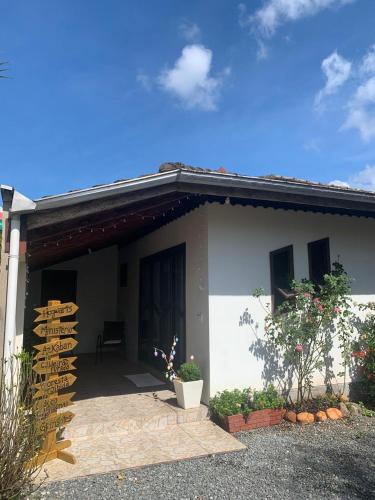
The town centre around Rua XV de Novembro and Rua Hermann Weege has 5–6 small pousadas at R$180–R$280 a night in low season, rising to R$280–R$380 during Blumenau's October Oktoberfest when Pomerode absorbs spillover guests who couldn't find a room there. The Rota do Enxaimel valley 5 km north has 3 farmhouse pousadas at R$220–R$350 — the more atmospheric choice if you have a car, since you wake up among the half-timbered houses rather than driving out to see them. City-centre apartment options like Apartamento tropical no centro de Pomerode suit those who want a kitchen and don't mind being a short walk from the square. Avoid anything advertising "próximo a Pomerode" that's actually in Testo Salto or Bracinho — those are 15–20 minutes' drive and lose the walkable-village appeal. Book the valley pousadas well ahead for weekends; they're tiny and fill with café colonial regulars.
Where to sleep
Hotels in Pomerode
Real, top-reviewed rooms — booked at the same live rate through app.impt.io, one tonne of carbon removed per stay.
★ 4.0 ★ 4.0
★ 4.0 ★ 4.0
★ 4.0 ★ 4.0
★ 4.0On the ground
Things to do in Pomerode
- Rota do Enxaimel by carThe signed 16 km loop through Testo Alto starts from the town centre at the tourist office (Praça Herbert Georg). Drive slowly with stops at 4–5 of the working farmhouses that serve café colonial (Casa Wachholz, Casa Weege, Pomerode Colonial). Allow 3–4 hours including a proper afternoon tea stop.
- Café colonial at Casa WachholzRua Testo Alto 4200, 6 km north of town. The most famous of the farmhouse café colonials — R$85 per person for a Saturday afternoon spread of homemade breads, cheeses, sausages, cakes, kuchen, jams. Reservations essential Saturday and Sunday, book by Thursday.
- Zoológico de PomerodeThe largest zoo in Santa Catarina, on Rua Hermann Weege 180 in the town centre. R$40 entry, open 8am–5:30pm daily. 1300 animals, decent enclosures for South American species, good for kids for 2 hours.
- Festa PomeranaPomerode's own version of Oktoberfest, held in January (not October) at Parque Municipal on Rua XV de Novembro. Smaller and more local than Blumenau's — actual Pomeranian folk dancing, bratwurst competitions, R$25 entry. Two weeks in mid-January.
- Museu PomeranoAt the eastern end of Rua XV de Novembro, close to the town centre walk's finish. R$10 entry, open Tuesday to Sunday 9am–5pm. Small but well-labelled collection of Pomeranian dialect recordings, farm tools and family photographs — 30 minutes is enough unless you read Portuguese and German both.
- Swimming at Rio do TestoA few informal river beaches along the SC-418 turn-off toward Testo Alto, popular with local families on hot weekends, free to use. No lifeguards and no facilities beyond a few picnic tables, so bring your own towel, food and water if you stop.
Getting around & the essentials
On foot
Start at the Igreja Luterana on Rua XV de Novembro, walk east past the town square (Praça Herbert Georg) with the tourist information office, continue along Rua Hermann Weege past the older commercial half-timbered facades and the entrance to the Zoológico de Pomerode, and finish at the Museu Pomerano at the end of Rua XV de Novembro. About 45 minutes at a slow pace including the museum stop, longer if the zoo tempts you inside.
By road
Yes for Rota do Enxaimel
Transport
From Blumenau it's a 30-minute drive north on SC-418 or 40 minutes by local bus (R$8). From Joinville 50 minutes south on SC-301. From Florianópolis 2h30 by car, intercity bus via Blumenau R$75. There's no train station and no airport — the nearest is Navegantes, roughly an hour away by rented car. Inside Pomerode you need a car for the Rota do Enxaimel — the loop is 16 km of narrow rural road with no bus service, so a taxi from the centre out and back will run R$60–R$80 if you're relying on one. The town centre itself is walkable in 30 minutes end to end, and bicycles can be rented informally through some of the town-centre pousadas for the flatter stretches of the rota.
Nightlife
Village quiet after 9pm
Good to know
Questions, answered
How is Pomerode different from Blumenau?
Pomerode is small, rural and genuinely German-descended in daily culture — the language survives at home, the farms are working farms, the half-timbered buildings are original. Blumenau is a much bigger industrial city with a downtown zone that plays up its German heritage for tourism but functions as normal Brazil. Pomerode for authenticity, Blumenau for scale.
When should I visit for café colonial?
Saturday and Sunday afternoons 2pm–6pm, when the farmhouse cafés on the Rota do Enxaimel actually open. Weekdays most are closed unless you have a group reservation. Book at least 2 days ahead by phone or WhatsApp — the tourist office in the town square keeps a current list of which farms operate on which days.
Is Pomerode worth a day trip from Blumenau?
Yes if you have a car — the 30-minute drive on SC-418 makes the Rota do Enxaimel and a café colonial easy in an afternoon. Without a car it's harder to justify, since the bus gets you to the town centre only and misses the farms, which are the actual point of coming. A day trip works well; an overnight only adds value if you're basing at one of the valley farmhouse pousadas.
Can I visit Pomerode without a car?
You can reach the town centre by local bus from Blumenau for R$8 and see the zoo, the Museu Pomerano and the church on foot in half a day. The Rota do Enxaimel farms, though, have no bus service and are 5–6 km out on narrow rural roads, so you'll need a taxi, a tour, or a rented car to reach the café colonials. Cycling is possible for the fitter and less time-pressed.
Keep exploring
Nearby areas
Doing good is the business: every booking through Stay Santa Catarina funds one verified tonne of carbon removal — same room, same price, no markup.
Start your search